
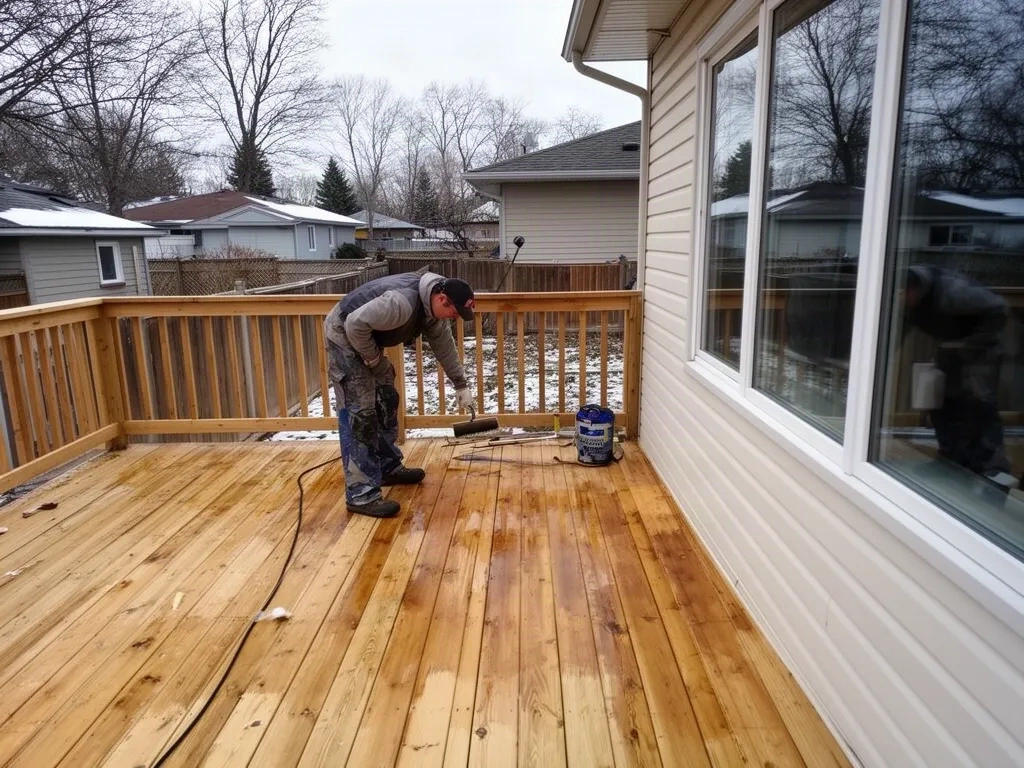
Penetrating Vs Film Stain For Winnipeg Winters
For Winnipeg decks, penetrating stains are the right choice, and film-forming stains will fail within one to two winters. The reason is simple: Winnipeg's freeze-thaw cycle is brutal, and a film stain, whether it's a solid acrylic or a paint-like product, traps moisture beneath its surface. When that trapped moisture freezes, it expands and pushes the film off the wood in sheets. A penetrating stain soaks into the cedar or pine, bonds at the fiber level, and flexes with the wood as temperatures swing from +30°C in July to -40°C in January.
The Science of Freeze-Thaw and Your Deck
Winnipeg sits on gumbo clay, which holds water like a sponge. That means your deck gets soaked from below as well as above. The freeze-thaw cycle, where the temperature crosses the freezing point dozens of times each winter, creates a relentless push and pull on deck boards. Wood expands and contracts, and a film stain cannot handle that movement. It cracks, peels, and flakes, which looks terrible and, worse, allows water to pool in the cracks and accelerate rot. Penetrating stains move with the wood, keeping the boards sealed and stable.
What Is a Film Stain?
Film stains (also called film-forming stains) are thin paints. They include solid acrylic stains, semi-solid acrylics, and even some urethane-based products. They form a plastic-like layer on top of the wood. This layer is what gives them their opaque, uniform color. But that layer is also their fatal flaw in Manitoba.
The numbers tell the story. A film stain on a Winnipeg deck typically needs a full strip and re-stain every 18 to 24 months. Because the film fails, you can't just recoat, you have to sand or chemically strip the old film off, which is labour-intensive and expensive. The cost of stripping alone often exceeds the cost of a premium penetrating stain application.
What is a Penetrating Stain?
A penetrating stain is a liquid that soaks into the wood's pores, carrying pigment and water repellents into the wood itself. It doesn't form a surface film. Think of it like sunscreen versus a plastic wrap, it absorbs and protects from within. Premium penetrating stains like Sikkens and TWP are engineered to handle extreme climates.
The numbers for Winnipeg are clear. A properly applied penetrating stain on a Winnipeg deck will last two to three years on a horizontal surface (the deck floor) and three to four years on vertical surfaces (railings and posts). When it's time to re-stain, you don't need to strip the old product. You just clean the deck and apply a new coat. This makes maintenance dramatically cheaper.
The Winnipeg Winter Test: What Actually Happens
Let's track a deck through a Winnipeg winter. In late November, the deck is covered in snow. The snow melts during the day, soaks into the wood, and then freezes at night. This cycle repeats dozens of times until spring. A film stain gets water under the film through tiny cracks or around nails. When that water freezes, it expands by about 9 percent. That expansion forces the film off the wood, creating a blister that eventually pops and peels. Once a film has a few blisters, it's a downhill slide.
A penetrating stain doesn't have that problem. The wood itself absorbs water, but the stain keeps the moisture from saturating the fibers. When the water freezes, the wood can expand slightly without damaging the stain because the stain is part of the wood, not a separate layer. The result: no peeling, no blistering, no flaking.
What About Solid Stains and Paint?
Solid stains and paint are film-forming products. They are the worst choice for Winnipeg decks. They look great for about six months, then the inevitable begins. The failure is ugly, with large flakes of color scattered across the deck surface. And when it's time to fix it, you're looking at a complete strip job.
If you absolutely want a solid color, a premium penetrating product like Sikkens Cetol SRD can give you a solid look without the film. It's a water-based penetrating stain that still allows moisture to escape. But for most Winnipeg cedar decks, a semi-transparent penetrating stain is the best choice, it shows the wood grain, protects the wood, and holds up to our winters.
What About Cedar and Pine?
Cedar is naturally rot-resistant, but it's also soft and porous. It absorbs penetrating stains beautifully. Pine and spruce decks need a bit more attention because they're more prone to cracking, but a good penetrating stain will still outperform a film stain. If you have a pressure-treated deck, the same logic applies. The key is that the wood must be dry before applying any penetrating stain. In Winnipeg, that means waiting for a stretch of 3-5 days without rain.
What We Use and Why
At Deck Staining Winnipeg, we use premium penetrating stains like Sikkens and TWP. These are not the $30 cans of film stain you'll find at the big-box stores. They cost more per litre, but they provide better protection and last longer. We don't use film-forming stains on any deck we work on. It's a simple rule: no film on a Winnipeg deck.
The Cost Difference
A film stain is cheaper to buy but more expensive to own. A deck that needs a film stain will require a full strip every two years. A penetrating stain deck just needs a clean and re-coat. Over a 10-year period, the penetrating stain approach is significantly cheaper, and it keeps your deck looking better.
Our pricing for penetrating stain applications is $400 to $1,500 for a standard deck. The final price depends on the size of your deck, the condition of the wood, and whether you need repairs. If your deck is in rough shape, our deck sanding and restoration service runs $600 to $2,000. We also offer fence staining ($300 to $1,200) and deck cleaning and power washing ($150 to $400) to keep your whole outdoor space in shape.
Why Choose Deck Staining Winnipeg
We're a deck-only crew. We don't paint houses or wallpaper rooms, decks are all we do. That means we know the specific problems Winnipeg decks face: the gumbo clay, the freeze-thaw, the UV summer. We use premium penetrating stains that flex with the prairie climate, and we do full prep work, sanding, brightening, and repairs, not just a coat of paint. We don't cut corners, and we don't pressure you. We'll give you a free quote within 48 hours, and we'll tell you honestly whether your deck is a good candidate for penetrating stain or if it needs a deeper restoration.
If you're in Winnipeg, or the surrounding bedroom communities like Steinbach, Selkirk, or Niverville, we can help. Get in touch for a free quote today and see the difference that a proper penetrating stain makes.